

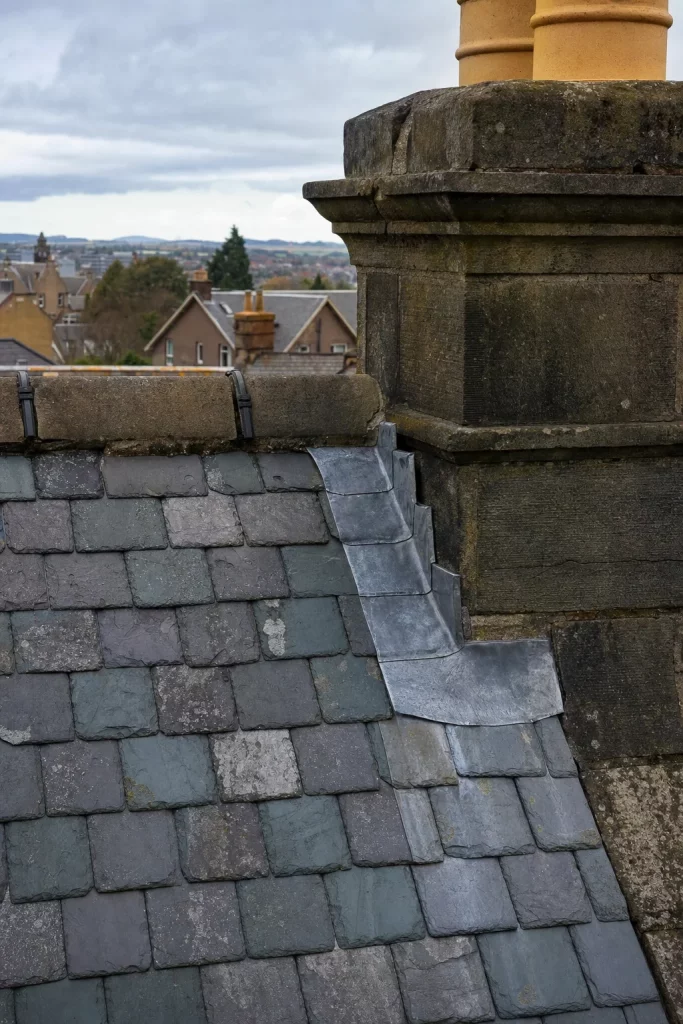
Lead Flashing Repair Kirkcaldy: Practical Fife Homeowner Guide
If you are searching for lead flashing repair Kirkcaldy, you are usually dealing with a leak around a chimney, wall abutment, valley, dormer, or roof joint. The key decision is whether the flashing can be repaired, needs partial replacement, or is hiding a bigger roof problem. This guide explains the warning signs, likely repair options, realistic UK costs, materials, timelines, and what Kirkcaldy and Fife homeowners should check before booking work.
Lead flashing is one of the most important weatherproofing details on a roof. When it fails, water often appears inside the house some distance from the actual fault, so a careful roof inspection matters.
What Lead Flashing Does on a Roof
Lead flashing forms a waterproof seal where the roof meets something else. On homes in Kirkcaldy, it is commonly found around chimneys, roof-to-wall junctions, skylights, dormers, parapet walls, and some valleys.
Because these areas are natural weak points, even a small crack, lifted edge, failed mortar joint, or poorly sealed chase can allow rainwater in. In windy coastal weather, driven rain can make a minor defect show up quickly.
Common Signs Your Lead Flashing Needs Repair
Not every damp patch is caused by flashing, but the following symptoms often point to a leadwork issue:
- Water staining on ceilings close to a chimney breast, upstairs wall, or loft area.
- Damp patches after heavy rain, especially when rain is wind-driven.
- Loose or lifted lead visible from the ground or from a safe inspection point.
- Cracked mortar where lead is set into brickwork.
- Gaps at step flashing on a roof-to-wall junction.
- Internal chimney damp that worsens during wet weather.
- Previous sealant patches that have split, peeled, or failed.
If water is already entering the property, it is best not to wait. Timber, insulation, plasterboard, and decoration can be damaged if the leak is left through several wet spells.
Typical Lead Flashing Repair Costs in Kirkcaldy
Costs depend on roof access, height, the extent of damaged lead, whether chimney pointing is needed, and whether tiles or slates must be lifted. The figures below are realistic guide ranges for UK residential roofing work, not fixed quotations.
| Repair type | Typical price range | Notes |
| Small flashing seal or localised repair | £120-£250 | Usually for a minor gap, lifted edge, or small leak with straightforward access. |
| Repointing lead chase around chimney | £180-£450 | May be needed when mortar holding the lead has failed. |
| Partial lead flashing replacement | £300-£750 | Common where a section is cracked, badly fitted, or fatigued. |
| Full chimney flashing renewal | £650-£1,500+ | Varies by chimney size, roof pitch, scaffold needs, and slate/tile work. |
| Scaffold or access tower | £250-£900+ | Sometimes essential for safe chimney or high-level work. |
A very cheap quote may only include surface sealant. That can be useful as a temporary measure in some cases, but it is not the same as properly dressed, fixed, and pointed leadwork.
Repair or Replace: How to Decide
The right option depends on the age and condition of the lead. Good lead can often be repaired if the fault is with the mortar or fixing. Replacement is more sensible when the material itself has split, thinned, buckled, or been cut too short.
Repair may be enough when:
- The lead is intact but the mortar chase has cracked.
- One edge has lifted due to failed clips or fixings.
- The leak is limited to a small, clearly identified point.
- The surrounding slates, tiles, and brickwork are in good condition.
Replacement is usually better when:
- The lead has fatigue cracks or splits.
- Previous patching has failed repeatedly.
- The flashing is poorly lapped or not dressed correctly.
- Chimney repairs are being carried out at the same time.
- The roof covering around the flashing is also being renewed.
Where chimney pointing, ridge repairs, slate repairs, or tile repairs are needed, combining the work can reduce disruption and access costs.
Materials Used for Proper Lead Flashing Work
For most domestic roofs, the repair should use suitable rolled lead sheet of the correct thickness for the detail. Using lead that is too thin, too long in one piece, or fixed too tightly can encourage future splitting. Lead expands and contracts with temperature changes, so correct laps, fixings, and dressing matter.
Common supporting materials can include lead clips, suitable mortar, breathable underlay repairs where needed, replacement slates or tiles, and lead sealant in specific joints. Sealant alone should not be relied on as the main waterproofing method for a permanent repair.
How Long Does Lead Flashing Repair Take?
Most small lead flashing repairs can be completed in half a day to one day, depending on access and weather. Larger chimney leadwork or roof-to-wall flashing replacement may take one to two days, especially if scaffold is required or if surrounding tiles and slates need careful removal and refitting.
Wet, icy, or high-wind conditions can delay roof work. In an active leak, a roofer may be able to carry out a temporary weatherproofing measure first, then return for the permanent repair when conditions are safer.
A Practical Checklist Before You Book a Roofer
Before arranging lead flashing repair in Kirkcaldy, use this quick checklist:
- Take photos of internal damp patches and note when they appear.
- Check whether the issue happens only in heavy wind and rain.
- Look from ground level for lifted lead, missing mortar, slipped slates, or damaged tiles.
- Do not climb onto the roof yourself.
- Ask whether the quote includes access equipment, materials, waste removal, and VAT if applicable.
- Confirm whether the repair is temporary, localised, or a full replacement.
- Ask if related chimney pointing, gutter repairs, ridge repairs, or slate repairs are needed.
A clear inspection should identify the likely water entry point and explain why the recommended repair is suitable.
Why Fife Roofs Need Careful Flashing Checks
Kirkcaldy and the wider Fife area see a mix of older stone properties, post-war homes, newer estates, coastal exposure, and roofs finished in slate, tile, and flat roofing systems. Wind-driven rain from the Firth of Forth can expose weaknesses around chimneys and wall junctions that might not show in calmer weather.
Homes in areas such as Dysart, Kinghorn, Burntisland, Glenrothes, Leven, Thornton, and Lochgelly can face similar issues, especially where chimneys are ageing or previous roof repairs have used short-term patching. A local roofer should understand how Fife weather affects leadwork, pointing, rooflines, gutters, and chimney details.
When Lead Flashing Is Not the Only Problem
Sometimes the flashing looks suspicious, but the leak is actually caused by another nearby defect. Common related issues include cracked chimney cement, porous brickwork, damaged chimney pots, slipped slates, broken roof tiles, blocked gutters, failed valley linings, or flat roof edges discharging water badly.
This is why a proper roof inspection is important. Replacing good lead will not solve a leak caused by a broken tile above it. Equally, patching a tile will not solve failed chimney apron flashing. The aim should be to diagnose the roof as a system, not guess at the most visible defect.
Get Local Help with Leadwork and Roof Repairs
Fife Roofers carry out leadwork and roof repairs across Kirkcaldy and Fife, including slating, tile repairs, pointing, gutter repairs, ridge repairs, UPVC roofline work, chimney repairs, and new roof installations. If you need advice or want to arrange an inspection, call 01592 214038, visit https://www.fife-roofers.co.uk, or find us on Facebook at www.facebook.com/fiferoofers.
Lead Flashing Repair FAQs
How much does lead flashing repair cost in Kirkcaldy?
Small repairs often start around £120-£250, while partial replacement can be £300-£750. Full chimney flashing renewal may cost £650-£1,500 or more depending on access, scaffold, roof height, and the condition of surrounding tiles, slates, and pointing.
Can damaged lead flashing be repaired without replacing it?
Yes, if the lead is still sound and the issue is confined to a lifted edge, failed mortar chase, or minor local defect. If the lead is split, badly fitted, too short, or repeatedly patched, replacement is usually the better long-term option.
How long does a lead flashing repair usually take?
Many localised flashing repairs take half a day to one day. Larger chimney leadwork, roof-to-wall flashing, or repairs needing scaffold can take one to two days, with weather and access affecting the schedule.
Is a chimney leak always caused by failed lead flashing?
No. Chimney leaks can also come from cracked pointing, damaged flaunching, loose pots, porous brickwork, slipped slates, broken tiles, or blocked gutters. A proper inspection should confirm the cause before repair work starts.
Do Fife Roofers cover leadwork outside Kirkcaldy?
Yes, Fife Roofers work across Kirkcaldy and surrounding Fife areas. For advice on leadwork, chimney repairs, slate repairs, tile repairs, or gutter repairs, call 01592 214038.
Fife Roofers is part of The Roofing Company Scotland Ltd, operating local roofing teams across Scotland.